
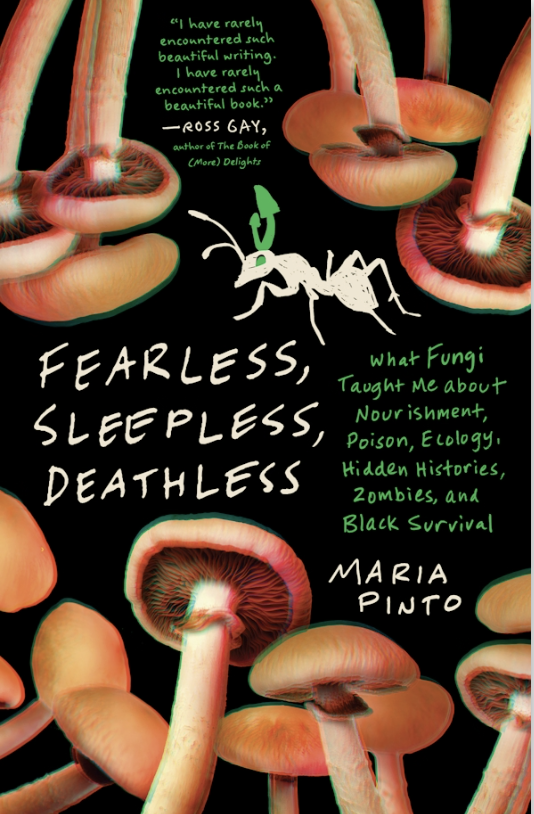
Book Review: Fearless, Sleepless, Deathless by Maria Pinto
Maria Pinto’s Fearless, Sleepless, Deathless is a masterful hybrid of memoir, ecological history, travelogue, cultural critique, and love song to fungi, structured to meander through a collection of meticulously crafted essays like a mycorrhizal network built not of organic matter, but of language. Using specific fungal species as narrative anchors, Pinto traces intertwined personal, colonial, ecological, and cultural histories while inviting the reader into a voice so personable it feels less like reading a book than walking alongside an endlessly curious and generous companion. Multiple times while reading, Pinto seemed to anticipate my exact questions, addressing in the very next paragraph what I'd just been wondering. How did she do that?!
The book resists rigid genre boundaries, much like fungi themselves resist neat taxonomies. Pinto’s prose moves with a Jack Kerouac–like looseness, a road-trip sensibility where chance encounters and travels, conversations with friends, and sudden intellectual detours become part of the method. This feels like Pinto’s deliberate style and it is so refreshing and contrary to formula. Her central argument that I took away, was that survival, knowledge, and healing emerge through entanglement and ‘sluttiness’ rather than domination, and this is continuously mirrored formally in each of the essays. It’s a grand literary display of ‘walking the talk’.
The opening chapter, centered on the Jamaican word for mushroom, ‘Junjo’, establishes Pinto’s revisionist project. She reminds us that fungi existed in Jamaica for millennia before colonial documentation, challenging the colonial logic that confuses “discovery” with origin. Drawing on a 1958 journal article titled “Mushrooms, Umbrellas, and Black Magic” by Irish anthropologist Robert Wallace Thompson, Pinto exposes how colonial science recorded Jamaican fungi while erasing Indigenous knowledge systems. Her observation that contemporary Jamaican mycophobia is an inherited colonial fear rather than a cultural origin becomes a powerful case study in how empire reshapes not only land but perception itself. Immediately the reader is invited to question established cultural norms or universal systems of knowledge without enquiry.
Pinto’s memoir voice deepens the analysis. Recounting her personal, family, friendships, and childhood relationship to land, she writes of fungi giving her “home in the way I used to know it as a child; that place where you essay to understand what earth is made of… where the land doesn’t end, but renders you continuous with it.” The study of mushrooms, she admits, taught her to see abundance where she had been taught scarcity, and to move beyond fear when “there isn’t plenty.” This is nourishment in the broadest sense: epistemological, emotional, and political.
Each chapter introduces a new fungal guide and a new human constellation. In the chapter on the Black Winter Truffle, Pinto visits a friend attempting to cultivate truffles, tracing the fraught history of luxury fungi and ultimately reconsidering her own skepticism about cultivation. Elsewhere, friendships with fellow mycophiles become sites of shared inquiry rather than expertise hierarchies. Knowledge here is relational, provisional, and lived.
One of the book’s most arresting chapters examines the zombie ant fungus alongside the Haitian roots of the zombie myth. Through conversations with her friend Kyle Bishop, Pinto reframes the zombie archetype not as a horror trope but as metaphor for the loss of agency under enslavement. She extends this analysis outward, naming prisoners, Black people, trans people, the colonized, the disabled, the elderly, children, and the global poor as populations living daily with constrained bodily autonomy. The essay’s power lies in its vulnerability: Pinto weaves her own empathy and unease into the analysis, refusing the safety of distance.
Poison becomes the organizing metaphor of the Death Cap chapter. Pinto details the horrifying efficiency of amatoxin poisoning, how it convinces the body it is healing while shutting organs down, and then turns the lens inward. Asking whether her own suicide attempts stemmed from the realization of her Blackness, she confronts “the endless accounting” and “the nasty lie of the official story.” Here, poison is reframed not as evil but as a survival strategy. Mushrooms evolved toxins to protect themselves long enough to reproduce. “Not everything is for us,” Pinto writes, a deceptively simple sentence she transforms into one of the sharpest anti-capitalist critiques in contemporary nature writing. I am left wondering, how profoundly changed would our world be if we all understood the real meaning of that short sentence? Mycophiles understand it more than most, and Pinto proudly claims these as her people.
In the chapter on psilocybin, Pinto navigates the ethical tensions of psychedelic medicine in Jamaica with care. She documents her own experiences with “laughing gyms,” discusses the work of MicroMeditations in Jamaica, and remains alert to the dangers of colonial extraction disguised as wellness. While acknowledging efforts to serve local communities and ethical considerations of commercial entities in post-colonial environments, she also honors figures like Miss Brown, who offered similar healing outside commercial frameworks long before Western interest arrived. The political thread continues, highlighting real solutions to heal sociopolitical divide through fungi: healing veterans, police, and first responders becomes a strategic bridge in the fight for legalization, suggesting that fungi may succeed where ideology fails.
Fire takes center stage in the chapter on Tinder Fungus, where Pinto moves seamlessly from Ötzi the Iceman to melaninated fungi like Pyronema. The revelation that mushrooms, too, are melaninated opens a quietly profound meditation on resilience. Fire, she argues, can be cleansing rather than destructive, an idea she extends to political protest. In one of the book’s most devastating passages, she recounts the killing of Tortuguita, a 26-year-old nonbinary environmental activist shot while protesting Cop City in Atlanta. Here, fire becomes both mourning and warning. Here she reflects, “good fire can prevent hellfire”.
The later chapters broaden into explicit calls for collaboration across difference. Referencing Anna Tsing’s The Mushroom at the End of the World, Pinto rejects rigid disciplinary boundaries in favor of what she jokingly, but seriously, calls “sluttiness.” To be “slutty,” in her formulation, is to be curious, promiscuous with ideas, willing to enter spaces that don’t yet make sense. Science, she reminds us, is a story a culture tells based on what it can perceive. Compartmentalization is the real danger. She advocates for cross-pollination of concentrations but stops short of calling it interdisciplinary.
This argument carries feminist force as well. Through figures like Blacki, a self-taught mycologist who built their own lab, Pinto champions forms of knowledge long dismissed as unserious or impure. Nature is not zero-sum, she insists, and neither should we be. Mushrooms, in her telling, are not metaphors imposed on the world, they are collaborators showing us how to survive together.
Fearless, Sleepless, Deathless ultimately imagines a world I want to live in: one where listening to nature is an act of political resistance, where curiosity dissolves false boundaries, and where survival is collective rather than competitive. Pinto does not offer easy solutions. Instead, she offers companionship, humility, and hope, threaded together like mycelium beneath our feet, waiting for us to notice.
Publisher: University of North Carolina Press